Mailgun review (2026): pricing, and why not for cold email
Mailgun pricing verified: free 100 emails a day, Basic $15 a month, Foundation $35, Scale from $90. Why its consent rules rule it out for cold email.
Mailgun at a glance
Facts checked Oct 8, 2026 on mailgun.com
- Price
- From $15 per month for Basic with 10,000 emails; Foundation $35 for 50,000 or $75 for 100,000; Scale from $90 for 100,000
- Pricing model
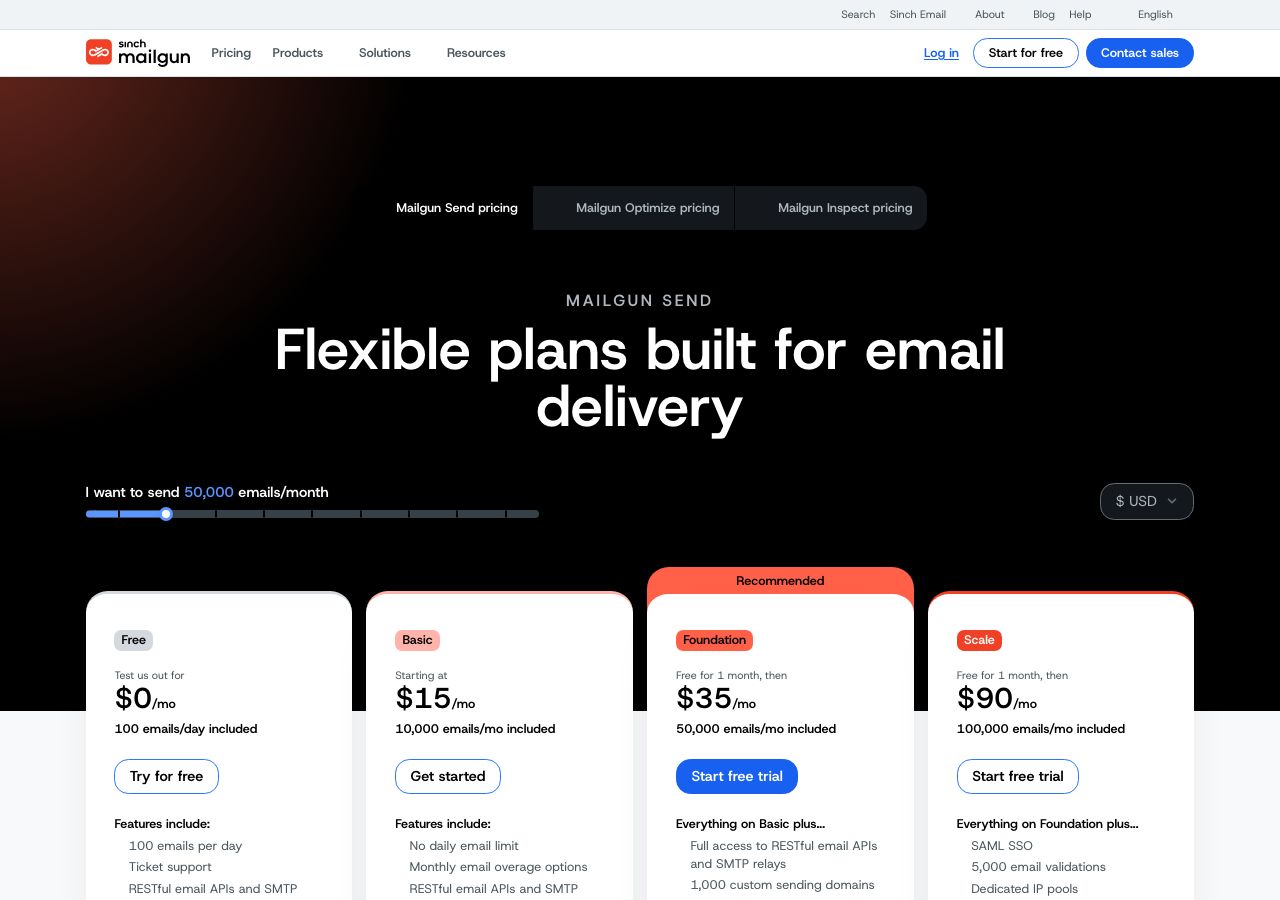
- Monthly plans priced by volume, in US dollars, euros or pounds. Free sends 100 emails a day with one custom sending domain and a day of logs. Basic is $15 a month for 10,000 emails with no daily limit and overage from $1.80 per 1,000. Foundation is $35 for 50,000 emails or $75 for 100,000, with 1,000 custom sending domains, templates, five days of logs and inbound routing, and its first month is free. Scale is $90 for 100,000 emails, $215 for 250,000, $400 for 500,000, $550 for 750,000, $700 for 1 million and $1,250 for 2.5 million, with SAML SSO, 5,000 email validations, a dedicated IP, send time optimisation, phone and chat support and 30 days of logs, also with a free first month. Overage on Scale falls from $1.10 to $0.40 per 1,000 as volume rises, and Enterprise is quoted.
- Minimum order
- None
- Free trial
- Free plan of 100 emails a day; Foundation and Scale start with a free month
- Billing
- Monthly, renewing automatically; the self-service terms ask for 30 days' written notice of non-renewal and set out no refund policy
- Setup time
- Minutes for an API key, plus DNS records to verify each sending domain
- DNS setup
- You add Mailgun's DNS records for each sending domain at your DNS host
- IP location
- Shared pools on the lower plans; one dedicated IP included on Scale, with dedicated IPs available from 50,000 emails a month
- Warmup
- Automated warmup for dedicated IPs on Scale; there are no mailboxes to warm
- Replacements
- Not applicable
- Domains
- Bring your own: 1 custom sending domain on Free and Basic, 1,000 on Foundation and Scale
- Integrations
- SMTP relay, REST API, Webhooks, Inbound routing, Email validation API, US and EU regions
Best for: Developers sending transactional and opted-in email through an API, especially teams that need EU data residency.
Not for: Cold outreach of any kind; use real mailboxes with warmup and a sequencer instead.

Mailgun pricing
Published prices as of Oct 8, 2026 from their pricing page. Prices change; check before you buy.
| Plan | Price | What you get | Notes |
|---|---|---|---|
| Free | $0 | 100 emails a day, 1 custom domain, 1 day of logs | Ticket support |
| Basic | $15 a month | 10,000 emails, no daily limit, 5 inbound routes | Overage from $1.80 per 1,000 |
| Foundation | $35 a month | 50,000 emails, 1,000 domains, templates, 5 days of logs | $75 for 100,000; first month free |
| Scale | From $90 a month | 100,000 emails, dedicated IP, 5,000 validations, SSO | Up to $1,250 for 2.5 million; first month free |
| Enterprise | Custom | Deliverability services, burst sending SLAs | Request a quote |
- Free$0
100 emails a day, 1 custom domain, 1 day of logs
Ticket support
- Basic$15 a month
10,000 emails, no daily limit, 5 inbound routes
Overage from $1.80 per 1,000
- Foundation$35 a month
50,000 emails, 1,000 domains, templates, 5 days of logs
$75 for 100,000; first month free
- ScaleFrom $90 a month
100,000 emails, dedicated IP, 5,000 validations, SSO
Up to $1,250 for 2.5 million; first month free
- EnterpriseCustom
Deliverability services, burst sending SLAs
Request a quote
What Mailgun does well
- Clear volume pricing from $15 a month, a free plan of 100 emails a day, and a free first month on Foundation and Scale.
- Send through the US or the EU region from one account, which keeps data where your compliance team wants it.
- Scale includes a dedicated IP with automated warmup, 5,000 validations, SAML SSO and phone and chat support.
- A 99.99% monthly uptime commitment in the terms, with service credits for downtime.
- 1,000 custom sending domains from Foundation up, with templates, inbound routing and webhooks for delivery events.
Where it falls short
- The acceptable use policy bans bought, rented or scraped lists and requires clear, explicit and provable consent from every recipient, which rules out cold email.
- It is a relay, not a mailbox: there is no inbox behind the message for replies and no Google or Microsoft reputation.
- The self-service terms renew monthly, ask for 30 days' written notice of non-renewal, and set out no refund policy.
- Log retention is short below Scale: one day on Free and five on Foundation.
- Basic's overage of $1.80 per 1,000 makes Foundation the cheaper plan above about 21,000 emails a month.
PureMail score for Mailgun
Five criteria, 1 to 5 each, scored on what Mailgun publishes. How we score.
3.2 / 5
- Price and value
- 4 / 5
- Setup and control
- 4 / 5
- Deliverability foundations
- 4 / 5
- Terms and support
- 3 / 5
- Fit for cold email
- 1 / 5
Published prices, effective cost per mailbox at 10, 30 and 100, no hidden fees. Unpublished pricing scores 1.
Time to first send, DNS automation, domain options, sequencer connection, ownership of domains and mailboxes.
Mailbox type and its inherited reputation, IP policy, warmup path, replacement policy for blocked mailboxes.
Minimum order, billing flexibility, refund and cancellation terms, support channel and hours.
Built and permitted for outbound, integrations with sequencers, warmup and verification tools.
What Mailgun is
Mailgun is an email API and SMTP relay for developers, owned by Sinch and sold under the Sinch Email name alongside Mailjet. Applications use it to send receipts, password resets and notifications, to receive inbound mail through routing rules, and to validate addresses before sending. It belongs in a cold email directory for the same reason SendGrid does: people look at it when deciding how to send outreach, and the answer is that it is built for something else.
How Mailgun’s pricing works
Prices rise with the monthly volume you choose on the pricing page. Free allows 100 emails a day with one custom sending domain and a day of logs. Basic costs $15 a month for 10,000 emails with no daily limit, and extra mail costs $1.80 per 1,000, so Foundation becomes the cheaper plan above about 21,000 emails a month. Foundation costs $35 for 50,000 emails or $75 for 100,000, and adds 1,000 custom sending domains, templates, five days of logs and inbound routing. Scale costs $90 for 100,000 emails and climbs through $215, $400, $550 and $700 to $1,250 for 2.5 million, adding a dedicated IP with automated warmup, 5,000 validations, SAML SSO, phone and chat support and 30 days of logs. Foundation and Scale both start with a free month.
The self-service terms run month to month and renew automatically, ask for 30 days’ written notice of non-renewal, and say nothing about refunds. Mailgun commits to 99.99% availability for its API, SMTP and delivery services, with service credits if it misses.
Why Mailgun is the wrong tool for cold email
Start with the policy, because it is explicit. Mailgun’s acceptable use policy prohibits acquiring or sending to third-party lists, names bought, rented and scraped lists, and allows non-transactional email only to people who gave clear, explicit and provable consent, through a single or double opt-in. You must be able to prove that consent when a complaint escalates, and the terms let Mailgun suspend the service for a breach. A cold list fails every one of those tests.
Then the mechanics. Relays are judged on complaint and bounce rates across everything they send, so they watch yours closely, and a cold campaign pushes both up quickly. On the lower plans you share IP pools with other customers, which is exactly why the policy is strict.
Finally the product. A cold email works when a prospect replies to a person. Mailgun sends from a domain you verify, but there is no mailbox behind it and no Google or Microsoft account lending it reputation; replies need inbound routing and your own handling.
What to use instead
The model that works is real mailboxes at a real provider, warmed up, spread across several domains, connected to a sequencer and held to conservative daily volumes. Every tool in our inbox provider category follows it, and it is what warmed Google Workspace and Microsoft 365 inboxes from PureMail are for. Keep Mailgun for the transactional mail your product sends.
Mailgun alternatives
For transactional email, SendGrid is the closest like-for-like, with a 60-day trial in place of a free plan. Postmark is stricter still about what it will send, and keeps transactional and broadcast mail on separate streams. Mailtrap adds a testing sandbox to its sending API. The SMTP relay category compares them.
Who Mailgun is for
Developers and product teams sending transactional and opted-in email through an API, particularly those who need EU data residency or a dedicated IP at moderate volume. For cold outreach, look elsewhere.
Mailgun alternatives we have reviewed
SendGrid
Twilio's transactional email API and SMTP relay: 60-day free trial, Essentials from $19.95 a month, Pro from $89.95 with dedicated IPs. Not for cold email.
Postmark
ActiveCampaign's transactional email service: free 100 emails a month, then $15 to $18 for 10,000 by plan, with separate broadcast streams. Not for cold email.
Mailtrap
Transactional email API and SMTP service from Railsware: 4,000 emails a month free, then $15 for 10,000 up to $1,250 for 2.5 million; unsolicited email barred.
Mailgun FAQ
How much does Mailgun cost?
As of 8 October 2026, Free sends 100 emails a day, Basic is $15 a month for 10,000 emails, Foundation $35 for 50,000 or $75 for 100,000, and Scale $90 for 100,000 rising to $1,250 for 2.5 million. Foundation and Scale start with a free month, overage runs from $1.80 per 1,000 on Basic down to $0.40 on the largest Scale tier, and Enterprise is quoted.
Can I send cold email with Mailgun?
No. Mailgun's acceptable use policy prohibits sending to lists that were bought, rented or scraped, and allows non-transactional email only to recipients who gave clear, explicit and provable consent, ideally through a single or double opt-in. It also requires proof of consent when an abuse complaint escalates, and the terms let Mailgun suspend accounts that break the policy.
Does Mailgun have a free plan?
Yes. Free sends 100 emails a day with one custom sending domain, the API and SMTP relay, webhooks, one inbound route and a day of logs, with ticket support. Foundation and Scale also begin with a free month before billing at $35 and $90 a month. The policy allows one free account per company.
Does Mailgun include a dedicated IP?
Scale includes one dedicated IP with automated warmup, and the plan comparison says dedicated IPs become available at 50,000 emails a month and are included from 100,000. A dedicated IP puts your reputation in your own hands, which helps steady, opted-in senders and does nothing for a cold list.
What should I use for cold email instead of Mailgun?
Real Google Workspace or Microsoft 365 mailboxes, warmed up, connected to a sequencer and spread across several domains at modest daily volumes. That is the model every inbox provider in this directory follows, and it is what PureMail sells. Keep Mailgun for the receipts, password resets and notifications your product sends.
Sources
Disclosure: PureMail sells Google Workspace and Microsoft 365 inboxes and competes with some tools in this directory. We do not assign star ratings and we do not take payment for placement. Spotted an error? Email [email protected] and we will correct it within a week.
More tools in the directory
Mailtrap
Transactional email API and SMTP service from Railsware: 4,000 emails a month free, then $15 for 10,000 up to $1,250 for 2.5 million; unsolicited email barred.
Postmark
ActiveCampaign's transactional email service: free 100 emails a month, then $15 to $18 for 10,000 by plan, with separate broadcast streams. Not for cold email.
SendGrid
Twilio's transactional email API and SMTP relay: 60-day free trial, Essentials from $19.95 a month, Pro from $89.95 with dedicated IPs. Not for cold email.
Setup guides from PureMail
How to Set Up SPF, DKIM and DMARC for Cold Email Domains
Step-by-step SPF, DKIM and DMARC setup for cold email domains on Google Workspace and Microsoft 365, plus the mistakes that quietly kill deliverability.