Clay review (2026): pricing, credits, pros and cons
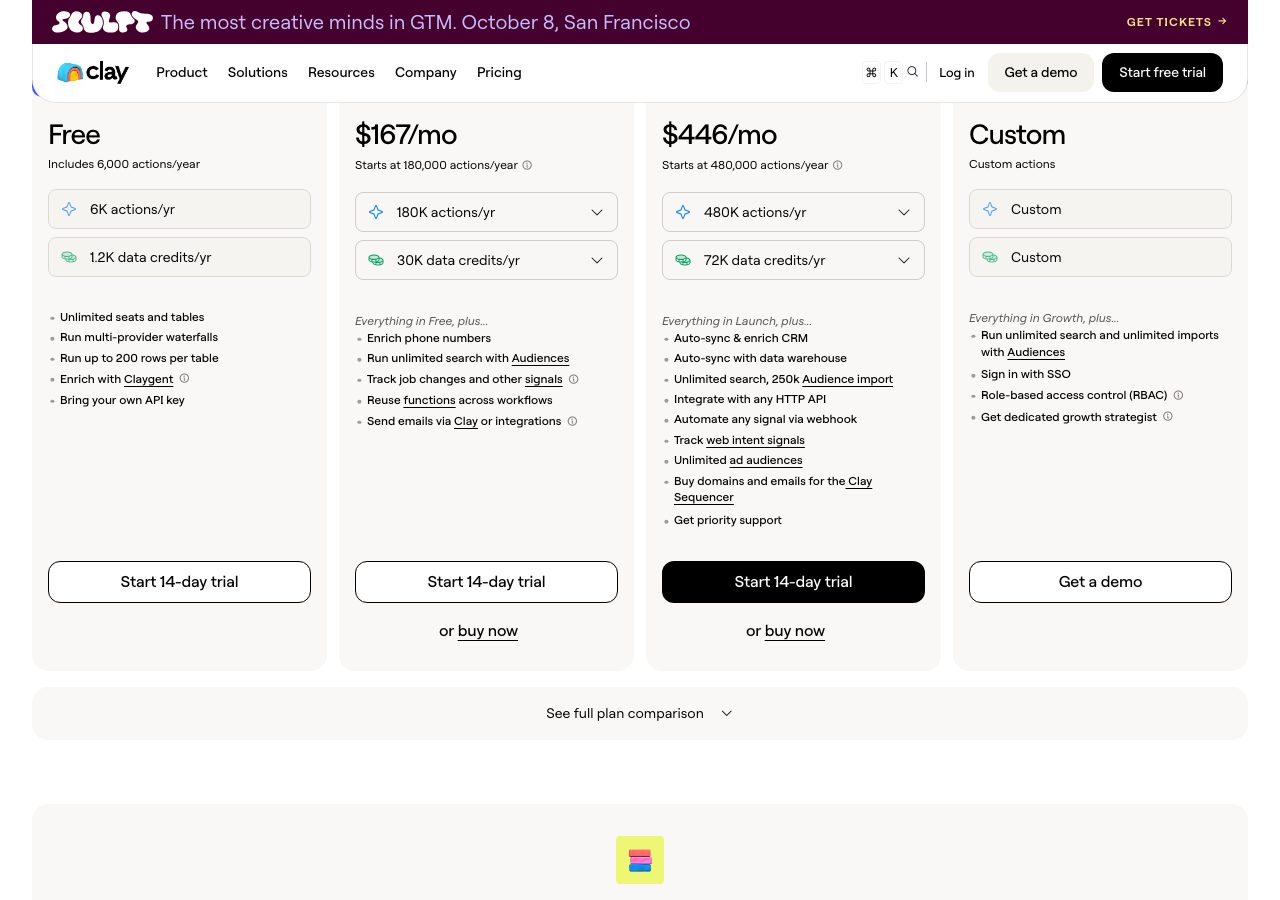
Clay pricing verified: free plan with 500 actions and 100 data credits a month, Launch from $185 a month or $167 yearly, Growth from $495 or $446. Verified.
Clay at a glance
Facts checked Oct 6, 2026 on clay.com
- Price
- From $185 per month for Launch on monthly billing with 15,000 actions and 2,500 data credits, or $167 billed yearly; free plan with 500 actions and 100 data credits
- Pricing model
- Two meters. Actions are the platform work Clay does on every row, such as calling a provider or running a step, and cost under a cent each. Data credits pay for data bought through Clay's marketplace of more than 150 providers; bring your own API keys and you skip them. Free: 500 actions and 100 data credits a month, up to 200 rows per table, unlimited seats. Launch: from $185 a month, which is 15,000 actions at $60 plus 2,500 data credits at $125, or $167 a month billed yearly for 180,000 actions and 30,000 data credits a year; each meter expands separately, up to 200,000 actions a month for $540 and 50,000 data credits for $2,125. Growth: from $495 a month, which is 40,000 actions at $205 plus 6,000 data credits at $290, or $446 billed yearly. Enterprise is custom with an annual commitment. Yearly billing saves about 10 percent and loads credits up front. Data credits roll over up to a month's worth, or 15 percent on annual plans; actions do not; top-ups cost a 30 percent premium.
- Minimum order
- None; the free plan needs no card
- Free trial
- A free plan plus a 14-day trial of the paid features
- Billing
- Monthly or yearly, auto-renewing at Clay's current rates unless cancelled before renewal; no refund terms are published
- Setup time
- Minutes for a first table; days to weeks to build a reliable workflow
- DNS setup
- Not applicable, though the Growth plan sells domains and inboxes for the Clay Sequencer
- IP location
- Not applicable
- Warmup
- Not applicable
- Replacements
- Data credits are spent only when you buy data from a provider; bring your own API keys and only actions are used
- Domains
- The Growth plan lets you buy domains and inboxes for the Clay Sequencer
- Integrations
- 150-plus data providers, HubSpot, Salesforce, Email campaign tools, HTTP API, Webhooks, Clay Sequencer, MCP
Best for: Outbound teams and agencies that want one place to build lists, enrich across providers, run AI research and push to a sequencer, with someone to build the tables.
Not for: Teams that want a simple finder at a flat price, or anyone unwilling to learn a spreadsheet-style workflow tool.

Clay pricing
Published prices as of Oct 6, 2026 from their pricing page. Prices change; check before you buy.
| Plan | Price | What you get | Notes |
|---|---|---|---|
| Free | $0 | 500 actions and 100 data credits a month, 200 rows per table | Unlimited seats |
| Launch | From $185 a month | 15,000 actions and 2,500 data credits, phones, signals, 50,000 rows per table | $167 billed yearly; meters expand separately |
| Growth | From $495 a month | 40,000 actions and 6,000 data credits, CRM sync, API, webhooks, intent | $446 billed yearly |
| Enterprise | Custom | 100,000-plus data credits, 200,000-plus actions, SSO, a strategist | Annual commitment |
- Free$0
500 actions and 100 data credits a month, 200 rows per table
Unlimited seats
- LaunchFrom $185 a month
15,000 actions and 2,500 data credits, phones, signals, 50,000 rows per table
$167 billed yearly; meters expand separately
- GrowthFrom $495 a month
40,000 actions and 6,000 data credits, CRM sync, API, webhooks, intent
$446 billed yearly
- EnterpriseCustom
100,000-plus data credits, 200,000-plus actions, SSO, a strategist
Annual commitment
What Clay does well
- Waterfall enrichment across more than 150 providers on one bill, with data credits spent only when a provider returns data, and your own API keys accepted to skip them.
- Claygent, an AI agent that researches companies and people from the web, plus signals for job changes, promotions, hiring and intent that trigger workflows.
- A real free plan with unlimited seats and tables, a 14-day trial of paid features, and published expansion tiers for both meters.
- Pushes everywhere: CRM auto-sync on Growth, email campaign integrations from Launch, HTTP API, webhooks, ad audiences, a native sequencer and an MCP server.
- Credit economics that are at least explicit: yearly plans load credits up front, data credits roll over within limits, and a dashboard tracks spend.
Where it falls short
- Two meters make budgeting hard, monthly billing costs about 10 percent more than yearly, actions do not roll over, and top-ups carry a 30 percent premium.
- It is a builder's tool: the GTM engineer job title exists largely because Clay tables take skill and time to make reliable.
- The free plan caps tables at 200 rows and Launch at 50,000, and the free plan excludes phone enrichment.
- Subscriptions renew at Clay's current rates unless cancelled before renewal, no refund terms are published, and Enterprise requires an annual commitment.
- Provider data varies in quality; the waterfall helps, but every email it returns still needs verifying before it reaches an inbox.
PureMail score for Clay
Five criteria, 1 to 5 each, scored on what Clay publishes. How we score.
3.6 / 5
- Price and value
- 3 / 5
- Setup and control
- 4 / 5
- Deliverability foundations
- 3 / 5
- Terms and support
- 3 / 5
- Fit for cold email
- 5 / 5
Published prices, effective cost per mailbox at 10, 30 and 100, no hidden fees. Unpublished pricing scores 1.
Time to first send, DNS automation, domain options, sequencer connection, ownership of domains and mailboxes.
Mailbox type and its inherited reputation, IP policy, warmup path, replacement policy for blocked mailboxes.
Minimum order, billing flexibility, refund and cancellation terms, support channel and hours.
Built and permitted for outbound, integrations with sequencers, warmup and verification tools.
What Clay is
Clay is a spreadsheet-style platform for building and enriching lead lists and automating what happens to them. Each row is a company or a person, each column a step: pull a list from an audience, enrich an email through a waterfall of providers, have Claygent, its AI agent, research a company from the web, watch for a job change or a funding round, then push the result to a CRM, an ad platform or a sequencer. It has become the hub of the modern outbound stack, to the point that the job title GTM engineer exists largely to describe the people who build on it. The company says it works with more than 150 data providers and, according to the New York Times, let employees sell shares at a $5 billion valuation.
Clay pricing
Clay bills two things. Data credits are spent when you buy data through its marketplace, such as an email, a phone number or firmographics from one of the providers; bring your own API key for a provider and you skip them. Actions are the platform work on every row, routing the request, calling the provider, running the step and writing the result, at under a cent each. Every plan includes an allowance of both, and each can be expanded on its own.
The free plan includes 500 actions and 100 data credits a month, unlimited seats and tables, waterfalls, Claygent and the Clay Sequencer, capped at 200 rows per table and without phone enrichment. Launch starts at $185 a month on monthly billing, which is 15,000 actions at $60 plus 2,500 data credits at $125, or $167 a month billed yearly for 180,000 actions and 30,000 data credits a year; it adds phone enrichment, signals, email campaign integrations and tables of up to 50,000 rows. Growth starts at $495 a month, 40,000 actions at $205 plus 6,000 data credits at $290, or $446 billed yearly, and adds CRM auto-sync, HTTP API integrations, webhooks, web intent, ad audiences, the ability to buy domains and inboxes for the Clay Sequencer, and priority support. Enterprise is custom with an annual commitment and starts from 100,000 data credits and 200,000 actions a month. Expansion is published: actions up to 200,000 a month for $540 and data credits up to 50,000 a month for $2,125, with yearly tiers about 10 percent cheaper.
The rules around credits matter. Yearly plans receive all credits up front. Data credits roll over up to a month’s worth on monthly plans and 15 percent of the annual allowance on yearly plans; actions reset each cycle. Top-ups cost a 30 percent premium. The terms say subscriptions renew at Clay’s current rates unless cancelled before renewal, and publish no refund policy.
How it works
Start a table from a search, a CSV, a CRM sync or one of Clay’s audiences, then add columns. An email waterfall asks provider after provider until one returns an address and charges credits only for the hit. Claygent reads websites, LinkedIn and news to answer a question you write in plain language. Signals watch for job changes, promotions, new hires, funding and web intent and can start a workflow when they fire. Functions let you reuse logic across tables. Outputs go to HubSpot or Salesforce, to email campaign tools, to ad platforms as audiences, to any HTTP API or webhook, to Clay’s own sequencer, or to an AI assistant through the MCP server.
Who Clay is for, and who should look elsewhere
Clay suits outbound teams and agencies that want one place to build lists, enrich across providers, run AI research and push to a sequencer, and that have someone willing to build and maintain the tables. It is a poor fit for teams that want a simple finder at a flat price, or anyone unwilling to learn a spreadsheet-style workflow tool. Apollo.io bundles a database, a finder and a sequencer at a published per-seat price, and ZoomInfo sells the enterprise database Clay often queries. The enrichment category and the lead data category list every tool we have reviewed with its score.
Using Clay with PureMail
Clay builds the list; the inboxes carry the reputation. Enrich and verify in Clay, then push to the email campaign tool where your Google Workspace or Microsoft 365 inboxes from PureMail are connected, or send through the Clay Sequencer, for which the Growth plan sells domains and inboxes of its own. Either way, verify what the waterfall returns, since provider data varies, and keep daily volumes per inbox conservative.
Clay alternatives we have reviewed
Apollo.io
B2B contact database plus a built-in sequencer: free tier, then $49, $79 and $119 a seat a month billed annually, with credits for emails and phones.
ZoomInfo
Enterprise B2B database with three quote-only tiers, one credit per exported contact, a Chrome extension, CRM integrations and a free trial.
Clay FAQ
How much does Clay cost?
As of 6 October 2026, the free plan includes 500 actions and 100 data credits a month. Launch starts at $185 a month on monthly billing, made up of 15,000 actions at $60 and 2,500 data credits at $125, or $167 a month billed yearly. Growth starts at $495 a month, 40,000 actions at $205 and 6,000 data credits at $290, or $446 billed yearly. Each meter can be expanded on its own, up to 200,000 actions a month for $540 and 50,000 data credits for $2,125. Enterprise is custom with an annual commitment.
What is the difference between actions and data credits?
Data credits are spent when you buy data through Clay's marketplace, such as finding an email, a phone number or company details across its 150-plus providers. Actions cover the platform work on every row: routing the request, calling the provider, running the workflow and returning the result, at under a cent each. If you bring your own API keys for a provider, you skip data credits and use actions only.
Is Clay free?
There is a free plan with 500 actions and 100 data credits a month, unlimited seats and tables, multi-provider waterfalls, Claygent and the Clay Sequencer, capped at 200 rows per table and without phone enrichment. New accounts also get a 14-day trial of the paid features.
Do unused Clay credits roll over?
Data credits roll over up to one month's worth on monthly plans and up to 15 percent of the annual allowance on yearly plans. Actions reset each cycle and do not roll over. Extra data credits can be bought at a 30 percent premium, and yearly plans receive all credits up front.
Can I use Clay with PureMail inboxes?
Yes. Clay builds and enriches the list and either sends through its own sequencer, for which the Growth plan sells domains and inboxes, or pushes to email campaign tools where your PureMail inboxes are connected. Verify every address the waterfall returns before it reaches an inbox, and keep daily volumes per inbox conservative.
Sources
Disclosure: PureMail sells Google Workspace and Microsoft 365 inboxes and competes with some tools in this directory. We do not assign star ratings and we do not take payment for placement. Spotted an error? Email [email protected] and we will correct it within a week.
More tools in the directory
Aerosend
Managed private-server inboxes for cold email at $4 a month each for the first 150 and $2 after, in batches of 30 with warmup, placement tests and burn alerts.
AgentMail
Email inbox API for AI agents: 3 inboxes free, 10 for $20 a month, 150 for $200, add-ons at $2 an inbox or domain and $2 per 1,000 emails, 20% off yearly.
Apollo.io
B2B contact database plus a built-in sequencer: free tier, then $49, $79 and $119 a seat a month billed annually, with credits for emails and phones.
Setup guides from PureMail
How to Set Up SPF, DKIM and DMARC for Cold Email Domains
Step-by-step SPF, DKIM and DMARC setup for cold email domains on Google Workspace and Microsoft 365, plus the mistakes that quietly kill deliverability.